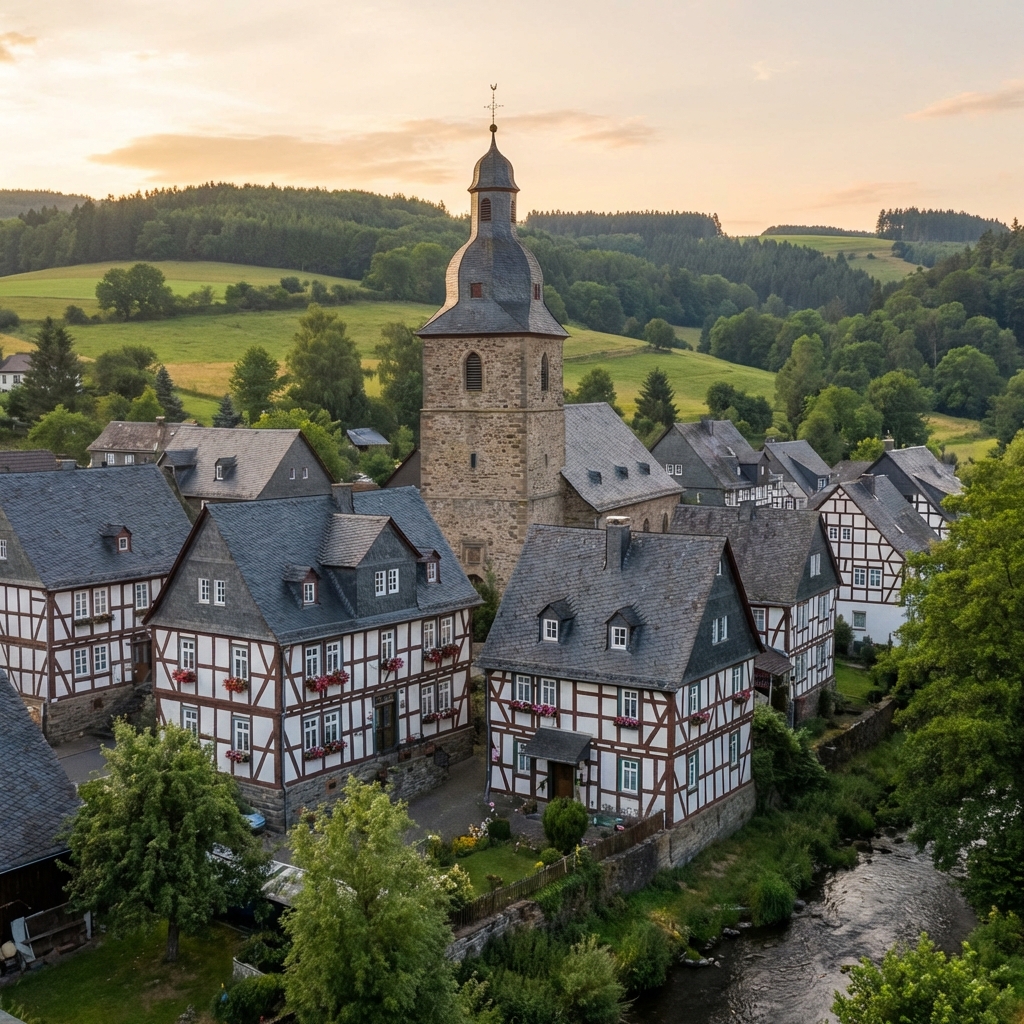
This is our village: Herborn-Seelbach. It lies in the Lahn-Dill district in the state of Hesse and has been part of the half-timbered town of Herborn as a district since 1977. The municipal territory lies in the "Glahn" area, a part of the Westerwald, at an elevation of 220 to 410 meters above sea level.
The name "Seelbach" first appears in a document of the Lorsch monastery in the year 772. That first mention, however, refers to the Seelbach that today belongs to the municipality of Lohra near Marburg. Our Seelbach was only mentioned later, in Nassau records.
Around the turn of the century, epidemic illnesses struck Herborn-Seelbach once more. It began in 1875/76 with 12 deaths from typhoid fever. In 1882, 26 children died of scarlet fever. Influenza, typhus and measles followed, and finally dysentery (1918), which claimed 54 lives despite an isolation barrack on the "Gewenn". On top of that, Herborn-Seelbach mourned 55 fallen soldiers in the First World War.
"In 1917, the 3 Seelbach bells also had to be sacrificed for the war. In 1919 the church tower received 2 new steel bells again, cast by Buderus in Wetzlar."
In 1902 our village was connected to the wider world, when the Aar-Salzböde railway from Marburg to Herborn opened. Between the two world wars, a gymnasium (1926/27) and a teacher's residence on the Hohenrain (1927) were built. Then the Second World War began. As everywhere, most of Seelbach's men went off to the front. 155 never returned.
The village itself was spared major war damage. Only when the Americans marched in on March 27, 1945, were a few buildings hit by light artillery. As an immediate consequence of the war, Herborn-Seelbach saw a considerable rise in population, through an influx of about 80 to 90 evacuees and homeless people as well as 321 expellees.
Today, with about 3,900 residents and a municipal area of 1,326 hectares, Herborn-Seelbach is the largest district of Herborn. Our community is proud of its more than 20 local clubs. The fellowship at cultural and sporting events, as well as the annual "Katzenkirmes" fair in September, has shaped our village in a major way.